Mainstream News has become the Band on the Titanic....
Alternative, Breaking, World News that Reports what the Mainstream Media Ignores.
Welcome to "The Honest Intelligence"
Please see Copyright information at bottom of page...

Wednesday, October 24, 2012

Russia: Syria rebels have US-made weapons

Rebel fighters fire from the rooftop of house against
Syrian government forces in the Bab el-Adid district
in Aleppo on 23 October 2012
A senior Russian general has said Syrian rebels now have anti-aircraft weapons, including US-made Stingers.

Gen Nikolai Makarov was quoted by the Interfax news service as saying the origin of the surface-to-air missiles should be "cleared up".

Russia is the biggest supplier of arms to its Syrian government ally.

Aerial bombardment of rebel-held towns continued on Wednesday, as the UN's Syria envoy prepared to brief the Security Council on ceasefire efforts.

Lakhdar Brahimi has been trying to arrange a ceasefire between rebels and government forces over the Muslim festival of Eid al-Adha, which begins on Friday.
Weapon supplies

"We have reliable information that Syrian militants have foreign portable anti-aircraft missile systems, including those made in the USA... it should be cleared up who delivered them," Gen Makarov told journalists in Russia.

There have been earlier unconfirmed reports of the Syrian opposition having shoulder-mounted missiles, but the West has been reluctant to openly arm the rebels.

In August, Syrian rebels said they had shot down a fighter jet near the border with Iraq.

Syrian warplanes have stepped up their bombardments of rebel-dominated areas in recent months, particularly in the north of the country. Deadly air raids are now daily events in towns around the city of Aleppo.

Recent footage has emerged of Syrian opposition fighters using old Soviet SA-7 heat-seeking missiles, which can destroy a plane flying at up to 14,000ft.

US-made Stinger missiles are shoulder-mounted anti-aircraft weapons designed to target low-flying planes and helicopters.

A US decision to supply them to the mujahideen in Afghanistan in the 1980s to fight the Russians proved to be a turning point in the war.

The UN says that more than 18,000 people have died so far in the uprising against Bashar al-Assad's government, which began in March 2011, but activists and opposition groups put the figure closer to 30,000.


Source

Bank of America Sued for $1bn for alleged Mortgage Fraud

Bank of America is being sued for $1bn (£624m) for alleged mortgage fraud.

The civil lawsuit has been brought by the US Attorney Preet Bharara, the top federal prosecutor in Manhattan, New York.

He accuses Countrywide Financial, which Bank of America bought in 2008, of selling thousands of toxic home loans to Fannie Mae and Freddie Mac.

Fannie Mae and Freddie Mac are government agencies that support the US mortgage market.

Bank of America has yet to comment.

Countrywide is accused of running a trading scheme from 2007 to 2009 that was deliberately designed to process loans at high speed without checks on their quality.

Mr Bharara said: "This lawsuit should send another clear message that reckless lending practices will not be tolerated."

He added that Countrywide's practices were "spectacularly brazen in scope."


Similar cases

The legal action against Bank of America follows similar moves by the US government earlier this month against Wells Fargo and JP Morgan Chase.

On 2 October, JP Morgan was sued for allegedly defrauding investors who lost more than $20bn on mortgage-backed securities sold by Bear Stearns.

JP Morgan, which bought the investment bank in March 2008, said the allegations related to actions at Bear Stearns prior to its takeover.

Meanwhile, on 10 October, Wells Fargo was also sued by federal authorities for alleged mortgage fraud.

The US government alleges that Wells Fargo lied about the quality of mortgages it handled, leading to huge losses for the Federal Housing Administration.

Wells Fargo has denied the allegations.


Source

*Just In* More US tuna contaminated — Study: Entire Food Web “Including Humans” May Be Affected as Fukushima Radionuclides Spread to West Coast

Title: Assessment and characterization of radionuclide concentrations from the Fukushima Reactor release in the plankton and nekton communities of the Northern California Current
 

Delvan Neville (Oregon St. Univ.), Richard D. Brodeur (NOAA), A. Jason Phillips (OSU) and Kathryn Higley (OSU)

jason-phillips
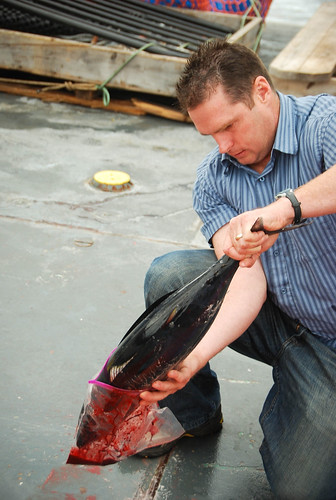
Fisheries researcher Jason Phillips bleeds a just-caught albacore tuna into a collection bag. The blood, along with all of the animal's skeletal, organ and muscle tissue, will be tested for traces of radiation. Photo by Cisco Werner, Southwest Fisheries Science Center.
The incident at the Fukushima Daiichi nuclear plant released a substantial radioactive contamination into the environment. With the predominant wind and current flow in this part of the North Pacific, these radionuclides will gradually spread to the US West Coast waters after a suitable period of time, with the possibility of affecting food quality throughout the food web (including humans). In addition to the passive transport by currents and winds, the migratory pathways of large pelagic fish extend from Japan to the Northern California Current. These organisms can serve as transport vectors for these nuclides, especially given their capacity to concentrate radionuclides from surrounding waters and prey. [...] By predicting the radio-biologic stress (if any) for a managed species as more Fukushima-related radionuclides are uptaken, appropriate action may be taken before significant population effects have occurred. Determination of natural background concentrations and high quality transport models produced from these data also aid in management in the event of a future accidental release, and in regulating safe activity releases.

Oregon State University Press Release, Oct. 24, 2012:

    [...] Phillips spent this summer collecting more fish at sea, off Oregon and Washington, as well as from scientists, fishermen and other sources along the West Coast. [...] As more fish were tested, the results were consistent with the initial findings: No Cs-134 in fish caught before the disaster, but traces of the isotope in a significant number of fish caught since. “This is what we’ve seen after testing about 70 pounds of tuna,” Neville said. [...]

No mention of the actual cesium levels detected in the tuna, only that it’s safe to eat.


Source

12 Earthquakes Hit Japan Today; All were near Fukushima Prefecture

(Reuters) - The situation at Japan's stricken Fukushima nuclear power plant has been stabilized but is still precarious, more than a year and a half after disaster struck, a senior Japanese regulatory official said on Wednesday.

In the world's worst nuclear accident in a quarter of a century, reactor meltdowns at the Fukushima facility after the March 2011 earthquake and tsunami sent radiation spewing over large areas, forcing more than 160,0000 people to flee.

"Overall, the conditions there have been maintained rather in a stable condition ... but there is no denying that the whole situation remains precarious of course," said Kenzo Oshima, a commissioner at Japan's Nuclear Regulation Authority (NRA).

The plant operator, Tokyo Electric Power Co (TEPCO), has taken extra safeguards and reinforcement measures concerning the spent fuel pool of Fukushima's No. 4 reactor in order for it to withstand any new earthquake, Oshima said.

"A lot of precaution, a lot of care, a lot of attention is still very much needed," he told reporters after meeting U.N. nuclear agency chief Yukiya Amano in Vienna.

In April, U.S. Senator Ron Wyden said after visiting the site that Japan, with assistance from the U.S. government, needed to do more to move spent fuel rods out of harm's way.

The NRA started operations in September, replacing two regulators that had been widely criticized for being too close to the industry they were supposed to monitor.

When a Reuters journalist went to the plant this month, workers were seen putting together water filtration systems and shifting equipment near the reactors, two of which remain capped by twisted steel and damaged concrete.

NRA head Shuichi Tanaka last week said it would impose tighter safety standards for nuclear plants. Japan's 50 reactors were shut after the disaster.

Oshima said the NRA would soon conduct an in-depth risk assessment regarding the Ohi nuclear facility, where two reactors were restarted this year despite warnings by some geologists of dangerous fault lines running beneath the plant.

Asked whether the plant could be shut as a result, he said: "It depends upon the findings, of course."

The regulator will abide by a government rule of a 40-year lifetime for reactors, even though it can be extended under certain circumstances by up to two decades, Oshima said.

"But basically I think the government has indicated its intention to have this rule applied as strictly as possible," he added.

(Reporting by Fredrik Dahl; editing by Jane Baird)

If The World Picked U.S. President, Election Would Be A Blowout

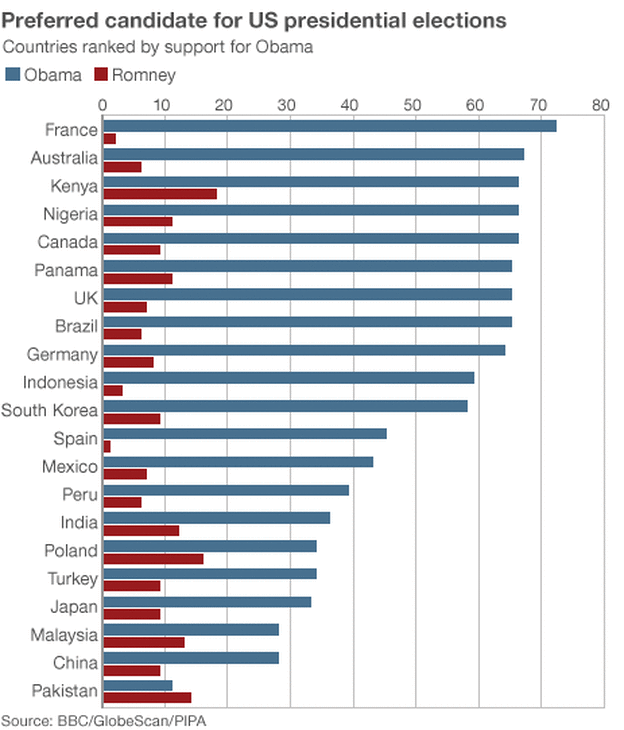
The presidential election here at home is neck and neck. The Real Clear Politics average of the popular vote puts Gov. Mitt Romney 0.6 percent ahead of President Obama.

But if the world had its say, this election would be a blowout favoring the incumbent.

That's according to a BBC World Service poll taken in 21 countries. It found for the most part, foreign countries preferred Obama. The only exception was Pakistan where more people said they preferred Romney.

Here's the key graphic:


More Deer Die-Offs Biological Hazard Event Reported on Tuesday, 23 October, 2012

Wildlife officials say a disease spread by biting flies has killed about 130 white-tailed deer in the state. Delaware Division of Fish and Wildlife officials reported that the outbreak of epizootic hemorrhagic disease started about 6 weeks ago. 

Officials say some 74 dead deer were found in Redden State Forest. Hunters and farmers are asked to report any dead deer to the Division of Fish and Wildlife.  

Biohazard name:     Epizootic hemorrhagic disease, cervids
Biohazard level:      
2/4 Medium
Biohazard desc.:     
Bacteria and viruses that cause only mild disease to humans, or are difficult to contract via aerosol in a lab setting, such as hepatitis A, B, and C, influenza A, Lyme disease, salmonella, mumps, measles, scrapie, dengue fever, and HIV. "Routine diagnostic work with clinical specimens can be done safely at Biosafety Level 2, using Biosafety Level 2 practices and procedures. Research work (including co-cultivation, virus replication studies, or manipulations involving concentrated virus) can be done in a BSL-2 (P2) facility, using BSL-3 practices and procedures. Virus production activities, including virus concentrations, require a BSL-3 (P3) facility and use of BSL-3 practices and procedures", see Recommended Biosafety Levels for Infectious Agents. 

 Source

.

Tuesday, October 23, 2012

The Sun Emitted an X1.8-class Flare

A solar flare on Oct. 22, 2012, as captured by NASA's Solar Dynamics Observatory (SDO) in the 131 Angstrom wavelength. This wavelength of light is used for observing solar material heated to 10 million degrees Kelvin, as in a solar flare. The wavelength is typically colorized in teal, as it is here. (Credit: NASA/SDO/Goddard)
Active Region on the Sun Emits Another Flare
10.23.12
The sun emitted a significant solar flare on Oct. 22, 2012, peaking at 11:17 p.m. EDT. The flare came from an active region on the left side of the sun that has been numbered AR 1598, which has already been the source of a number of weaker flares. This flare was classified as an X1.8-class flare.

"X-class" denotes the most intense flares, while the number provides more information about its strength. An X2 is twice as intense as an X1, an X3 is three times as intense, and on. An X-class flare of this intensity can cause degradation or blackouts of radio communications for about an hour.

Solar flares are powerful bursts of radiation. Harmful radiation from a flare cannot pass through Earth's atmosphere to physically affect humans on the ground, however -- when intense enough -- they can disturb the atmosphere in the layer where GPS and communications signals travel. This can disrupt radio signals for anywhere from minutes to hours.


The National Oceanic and Atmospheric Association, which is the United States government's official source for space weather forecasts and alerts, categorized the radio blackout associated with this flare as an R3, on a scale from R1 to R5. It has since subsided.

By observing the sun in a number of different wavelengths, NASA's telescopes can tease out different aspects of events on the sun. These four images of a solar flare on Oct. 22, 2012, show from the top left, and moving clockwise: light from the sun in the 171 Angstrom wavelength, which shows the structure of loops of solar material in the sun's atmosphere, the corona; light in 335 Angstroms, which highlights light from active regions in the corona; a magnetogram, which shows magnetically active regions on the sun; light in the 304 Angstrom wavelength, which shows light from the region of the sun's atmosphere where flares originate. (Credit: NASA/SDO/Goddard)

 Increased numbers of flares are quite common at the moment, since the sun's normal 11-year activity cycle is ramping up toward solar maximum, which is expected in 2013. Humans have tracked this solar cycle continuously since it was discovered in 1843, and it is normal for there to be many flares a day during the sun's peak activity. The first X-class flare of the current solar cycle occurred on Feb. 15, 2011 and there have been 15 X-class flares total in this cycle, including this one. The largest X-class flare in this cycle was an X6.9 on Aug. 9, 2011. This is the 7th X-class flare in 2012 with the largest being an X5.4 flare on March 7.

This flare did not have an associated Earth-directed coronal mass ejection (CME), another solar phenomenon that can send solar particles into space and affect electronic systems in satellites and on Earth.

Source: NASA’s Goddard Space Flight Center

Non-Lethal Missile Kills Computers And Electronics With EMP Burst

Credit AFR
Tuesday, October 23, 2012

Non-Lethal Missile Kills Computers And Electronics With EMP Burst

The Counter-Electronics High Power Microwave Advanced Missile Project (CHAMP) Joint Concept Technology Demonstration (JCTD) recently executed the flight-test Pointing Demonstration. This test demonstrated the navigational and pointing accuracy of the CHAMP aerial platform, as well as the ability to correctly trigger the payload with great timing accuracy.
CHAMP provides the warfighter a non-lethal, low collateral damage capability that can be used against targets currently on the kinetic restricted target list. The technical requirements for the CHAMP system came directly from warfigher-provided inputs. CHAMP supports Combatant Commands faced with increasing operational limitations by providing an option to achieve mission needs while keeping collateral damage and post-conflict reconstruction costs to a minimum.

Cruising fast over the Western Utah Desert, a lone missile makes history at the Utah Test and Training Range. The missile, known as CHAMP, or Counter-electronics High-powered Advanced Missile Project may one day change modern warfare, by defeating electronic targets with little or no collateral damage.

 On Oct. 16th at 10:32 a.m. MST a Boeing Phantom Works team along with members from the U.S. Air Force Research Laboratory (AFRL) Directed Energy Directorate team, and Raytheon Ktech, suppliers of the High Power Microwave source, huddled in a conference room at Hill Air Force Base and watched the history making test unfold on a television monitor.


Power is cut to a room of computers after being hit by a high-powered microwave pulse from a Counter-electronics High-powered Advanced Missile Project.

CHAMP approached its first target and fired a burst of High Power Microwaves at a two story building built on the test range. Inside rows of personal computers and electrical systems were turned on to gauge the effects of the powerful radio waves.


Seconds later the PC monitors went dark and cheers erupted in the conference room. CHAMP had successfully knocked out the computer and electrical systems in the target building. Even the television cameras set up to record the test were knocked off line without collateral damage.

“This technology marks a new era in modern-day warfare,” said Keith Coleman, CHAMP program manager for Boeing Phantom Works. “In the near future, this technology may be used to render an enemy’s electronic and data systems useless even before the first troops or aircraft arrive,”


In all, seven targets were hit using CHAMP’s high power microwaves in the one-hour test that degraded and defeated the electronics inside the test buildings.


James Dodd, vice president of Advanced Boeing Military Aircraft, part of Phantom Works said there is a real need for a weapon that can defeat a target and not cause harm to people and structures.


“We know this has some capabilities and some impact, we’re really trying to engage the customer to see if there is a way we can actually get this fielded and implemented sooner than later,” Dodd said.


Coleman, who led the Boeing team in the historic test flight, says the team is currently analyzing data and telemetry from the test that many consider a big step in modern non-lethal warfare.


“Today we turned science fiction into science fact,” Coleman said.


The Air Force Research Laboratory, Directed Energy Directorate's High Power Microwave Division, is developing a multi-shot and multi-target aerial, high-power microwave (HPM) demonstration system to Deny, Disrupt, Degrade, and Destroy an adversary's electronic systems.


The CHAMP JCTD will develop and test a counter-electronics capability that integrates a HPM source into an aerial platform. HPM beams disrupt or damage targeted electronic circuits and components through various physical avenues. Through several years of testing, AFRL has proved these counter-electronics HPM effects. Several tests are being performed to demonstrate the capability; one major testing milestone is the Pointing Demonstration.


Contacts and sources:
By Randy Jackson

Boeing