Mainstream News has become the Band on the Titanic....
Alternative, Breaking, World News that Reports what the Mainstream Media Ignores.
Welcome to "The Honest Intelligence"
Please see Copyright information at bottom of page...

Tuesday, November 6, 2012

New Flyover Videos Confirmed New Large Louisiana Sinkhole Collapse

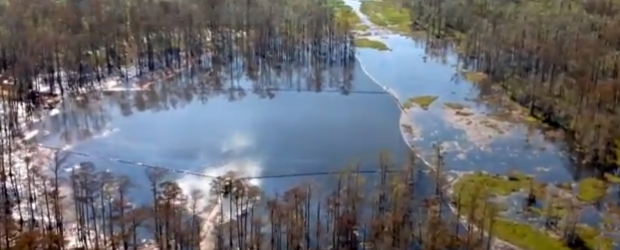
Disturbing new flyover videos of Louisiana sinkhole showed the amount of land collapsed has increased in size. Last measurements show that the surface of the sinkhole area was 5.5 acres, or equivalent of five football fields.  Based on John Boudreaux, director of Assumption Parish Department of Homeland Security and Emergency Preparedness stated that  the surface is now closer to the size of six football fields according to the Examiner. The sinkhole occurred early on August 3 in swampland between Bayou Corne and Grand Bayou.

Sinkhole size comparison (Credit: Yeoldefalseflag.com)
On October 30, a large slough in occurred at the sinkhole site . The size was estimated to be a 20 feet by 80 feet section located on the east side of the sinkhole according to Assumption Parish Police Jury.

According to  Boudreaux, based on a pre-collapse, ground-based photograph of the site and Google Earth-based mapping software used for aerial photographs of the site before and after the Tuesday’s collapse, the area of sinkhole increased to roughly 300 feet along the eastern bank and 100 feet inland, within 10 feet for irregularly shaped collapse zone. However, responsible Texas Brine, disputed this figure, giving new values of 50 to 75 linear feet of the sinkhole bank by 15 to 20 feet inland, an area possibly as small as 750 square feet. On August 3, the size of the sinkhole was said to be approximately the size of two football fields.
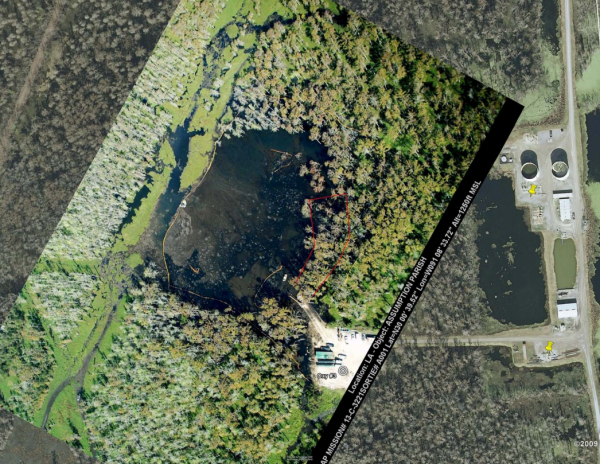
Sinkhole slough in map from October 31, 2012 (Credit: Assumption Parish)
 After shutting all pipelines, Department of Natural Resources determined that pipelines are not cause of bubbles. Staff has reviewed 23 hydrocarbon storage and 36 brine cavern wells  and associated cavern files which represents 100% of the cavern wells  on the dome bubbles.  Hydrocarbons and dissolved natural gas were confirmed in water at slurry site. Results show slightly elevated chlorides at surface samples, deep samples also shows  elevated salinity as well as indicators of natural gas. Results indicate petroleum hydrocarbons dominated by diesel range organics, same as samples collected on August 4. Shaw E&I has confirmed the hydrocarbon material to be unprocessed crude oil.
As of 30 October, Texas Brine has removed 102 roll off boxes hydrocarbon contaminated debris and approximately 935 barrels of hydrocarbons from the surface of the sinkhole.
Section for Environmental Epidemiology and Toxicology (SEET) has received and is analyzing community ambient air sampled from August 28,2012 until October 30, 2012 (MultiRAE). SEET  will issue a letter to the parish in reference to these  findings once the review of the data has been completed.
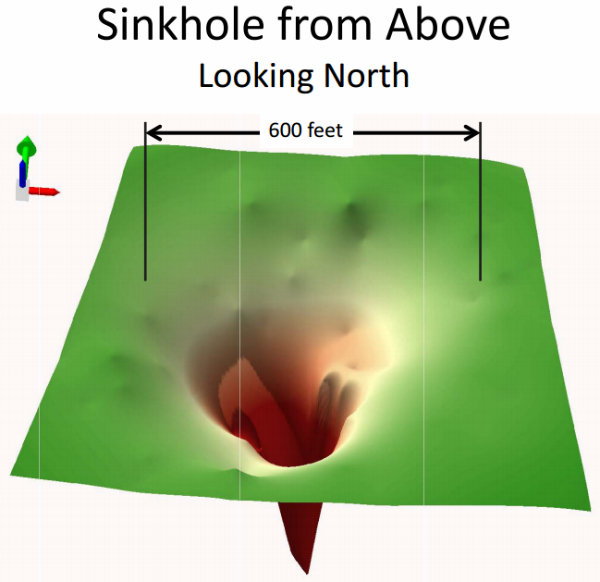
Graphic showing sinkhole from above (Credit: DNR Louisiana/Public Briefing October 23, 2012.)

Earthquake connection?

USGS monitor seismic activity at the six seismograph locations. According to USGS, an average of one tremor a day is occurring, in the direction northwest of the sinkhole.
In response to Texas Brine’s assertion that region seismic activity caused their cavern to be compromised, USGS stated on October 25 Sept. 2012 that it is their belief that the seismicity is a consequence of the collapse of the cavern, and not the cause of the collapse of the cavern and the formation of the sinkhole. Dr. Horton of the USGS stated the science behind the recent events does not suggest a heightened level of risk at this time.
Dr. Gary Hecox with Shaw Environmental and Infrastructure evaluated the readings from the USGS monitoring equipment, following recent reports of seismic activity on the western side of the Napoleonville Salt Dome. The Center for  Earthquake Research and Information (CERI) registered a short duration, pronounced seismic event at a depth of approximately 500 meters (1,600 feet). After reviewing data from the cavern pressure monitoring system and sinkhole bubble activity. Shaw pointed that this event did not have any discernible effect on cavern pressure or sinkhole bubble activity at the time. However, many suspect extra drilling into the salt dome produced earthquake swarm in the same area, six days before new collapse.

source

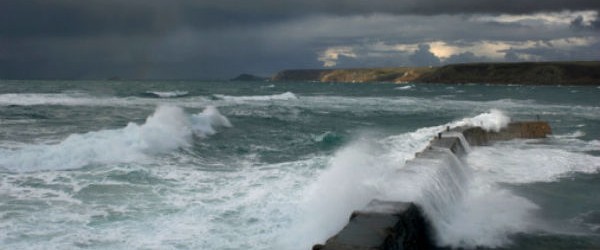
Gulf Coast Storm System About to Deepen into East Coast Nor’Easter

Storm along the central Gulf coast will move eastward to the eastern Florida coast and deepen into nor’easter storm which will form off the coast of South Carolina on Tuesday evening. The storm is forecasted to accelerate north-northeastward on Wednesday, with a central pressure expected near 984 mB . The system is expected to travel northward paralleling the east coast northward to off the Delmarva Peninsula by Wednesday morning. This will affect the areas that were hardest hit by Hurricane Sandy last week. It should intensify into a medium-strength nor’easter storm, pulling in cold Arctic air from Canada. As the storm strengthens, winds are expecting to reach 95 to 115 km/h ( around 60 to 70 mph).

High, battering waves, could cause severe erosion along the coastal areas pounded by Hurricane Sandy last week. Beach erosion caused by Sandy and washed up sand dunes could hardly stop the surge, especially along the New Jersey coastline.  A storm surge of 2 – 4 feet would likely hit the New Jersey coast, and a storm surge of 3 – 5 feet would likely impact the western end of Long Island Sound.

At the present time, AccuWeather.com meteorologists are expecting a 2 to 4-foot water rise on top of the tide level from about Ocean City, Md., through Atlantic City, Belmar and Sandy Hook, N.J. The worst of coastal flooding is expected Wednesday afternoon and again late Wednesday night, as the hide tides appearing that day. There isn’t much protection in place to hold the water back so coastal residents are urged to take precaution against more rising water.

Forecast rainfall totals for the next five days (Credit: NOAA)
 Saturated ground will receive additional rain amounts which will lead to flooding of low-lying and poor drainage areas, causing streams and creeks to rise over their banks.

 Nor’easter has the potential to bring more than a foot of snow to mountain areas of New England. Additional power outages and damage to trees will be likely due to the already soft saturated ground in place across the region. About 1.26 million people are still without power in the Northeast.

source

Devastating Floods in Nigeria has Displaced More than 2 Million People

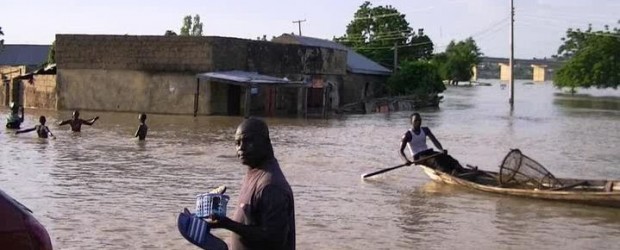
Since July, devastating floods affected 30 of the Nigeria’s 36 states, displacing more than 2 million people.  The Nigerian Red Cross said there’s no telling when families will be able to return, and when they do, they will need help rebuilding their homes, and their lives. Situation in camps is serious – there is severe lack of food and clean drinking water. President Goodluck Jonathan has promised to release additional funds for the procurement of medicine and seedlings for victims, particularly those in Benue state. Punch reported that severe hunger has hit over 400 children at Ula-Ehuda Camp in Ahoada East Local Government Area of Rivers State. There is also a high risk of epidemics breaking out in the affected areas.

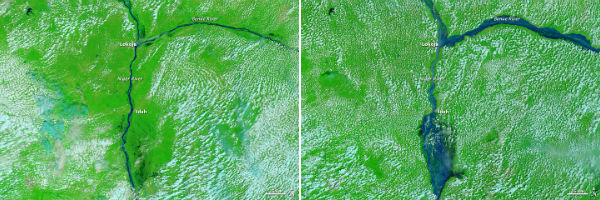
Flooding started in Plateau State in central Nigeria in July, spread through Borno, Cross River, Ebonyi, Nassarawa, Bauchi, Gombe, Katsina and Kebbi states in August, hit Taraba Benue, Niger, Kaduna and Kano in September, before affecting Delta and Bayelsa states in September and October. The Benue and Niger Rivers converge in southern Nigeria, and from there the Niger flows south toward the sea.

The Moderate Resolution Imaging Spectroradiometer (MODIS) on NASA’s Terra satellite captured these images of the confluence of the Niger and Benue Rivers on October 20, 2008 (left) and October 13, 2012 (right) (NASA images courtesy LANCE MODIS Rapid Response Team at NASA GSFC. Caption by Michon Scott)

According to the National Emergency Management Agency (NEMA), 431 fatalities have been reported and many more are considered missing.  2.1 million others were displaced. Floods caused major damage to crops, livestock and infrastructure, destroying roads and bridges. According to Emenike Umesi, NEMA’s zonal coordinator in Port Harcourt, thousands of houses, health clinics and hospitals, as well as dozens of schools, churches and government buildings have been destroyed or damaged in Delta State. Many displaced residents are wondering why the government has not done more to prevent flooding which occurs every year during the August to October rainy season in these low-lying areas. Flash floods are common in Nigeria in the rainy season (May to September), but news reports characterized this year’s floods as the worst in more than 40 years. Rainy season is not over yet and more flooding is expected.

John Campbell, a senior fellow at the Council on Foreign Relations and a former U.S. ambassador to Nigeria wrote that the United Nations and other organizations have “sounded the alarm” at the approach of similarly large-scale humanitarian crises in the region, accusing  Western media for entirely ignoring the problem according to VOA.

source

Nor’eastern Storm About to Hit East Coast, Bringing More Fears of Coastal Flooding and Beach Erosion

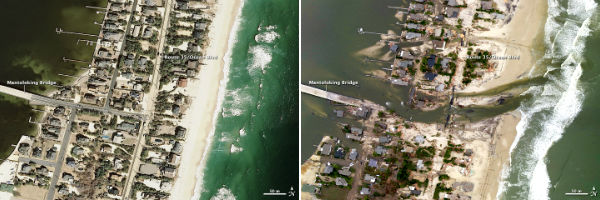
Portion of the New Jersey coastal town of Mantoloking, just north of where Hurricane Sandy made landfall. The left image was taken on March 18, 2007 by the Remote Sensing Division of the National Oceanic and Atmospheric Administration (NOAA) and the right image on October 31, 2012 acquired by the same group (Credit: Aerial photography courtesy of the NOAA Remote Sensing Division. Caption by Mike Carlowicz)
A nor’easter is predicted to potentially hit the East Coast around November 7 while it still recovering from devastation caused by Hurricane Sandy. Nor’easters usually bring massive amounts of precipitation, high winds, large waves, and marginal storm surge to coastal areas. According to Brian McNoldy, a weather researcher at the University of Miami, the new storm’s path is predicted to move from the Southeast to New Jersey. The worst impact will be the coastal flooding and beach erosion, backed up by strong winds and enhanced swells and waves, regardless of how far off the coast system could be.

credit http://www.wunderground.com/

Fears of further beach erosion and coastal flooding

Experts are concerned about further beach erosion, already devastated by Sandy. Even if the new nor’easter system wont gain the strength as Sandy, because hundreds of miles of dunes and protective seawalls tore apart or eroded after Sandy’s impact, it could still lead to flooding along lowland coastlines.
Record surge and pounding waves generated by Sandy destroyed hundreds of homes and buildings along the East Coast. Rockaway Beach (on a peninsula in New York City’s borough of Queens) was almost completely washed away and the boardwalk was destroyed. Jones Beach (a barrier island off Long Island) was overwashed by ocean. Gilgo Beach’s dune system (on Long Island) was almost destroyed, and Ocean Parkway (which runs along the southern end of Long Island) was overwashed. New Jersey’s Long Beach Island sustained severe damage, with boats and cars tossed into streets and several feet of sand piled against houses.

Increasingly vulnerable sandy beaches

Hilary Stockdon, a research oceanographer with the U.S. Geological Survey in Reston, Va. said the beaches and sand dunes are the first line of defense for coastal communities against storm surge and waves. According to USGS, many of the sandy beaches along the Atlantic Coast have become increasingly vulnerable to significant impacts due to erosion during past storms like Hurricanes Ida (2009) and Irene (2011), as well as large storms in 2005 and 2007.
USGS report released in February 2011 said that East Coast beaches have been steadily eroding for 150 years. The beaches in New England and the Mid-Atlantic are losing about 1.6 feet (0.5 meters) per year on average. The worst erosion case was about 60 feet (18 m) per year at the south end of Hog Island, in southern Virginia.
The sandy Mid-Atlantic coast — stretching from Long Island, N.Y., to the Virginia-North Carolina border — is eroding faster than the rocky New England coast, the USGS report found. Still, the majority of the coast is eroding throughout both regions, suggesting erosion could become a bigger problem.
Sandy’s late October arrival also increased coastal vulnerability by removing sand that had been naturally stored offshore for summer beach replenishment. During the winter, sand is stored in sandbars and comes back in the summer.


Nor’easter

A nor’easter is a type of macro-scale storm along the East Coast of the United States and Atlantic Canada. This type of storm has characteristics similar to a hurricane. More specifically it describes a low-pressure area whose center of rotation is just off the East Coast and whose leading winds in the left forward quadrant rotate onto land from the northeast. The precipitation pattern is similar to that of other extratropical storms. Nor’easters usually cause severe coastal flooding, coastal erosion, hurricane force winds or blizzard conditions, usually accompanied with very heavy snow or rain, depending on when the storm occurs.
Nor’easters can be devastating and damaging, especially in the winter months, when most damage and deaths are cold-related, as nor’easters are known for bringing extremely cold air down from the Arctic air mass. Nor’easters thrive on the converging air masses – the polar cold air mass and the warmer ocean water of the Gulf Stream.
The low enhances the surrounding pressure gradient, which acts to spiral the very different air masses toward each other at an even faster rate. The greater the temperature differences between the two air masses the greater the turbulence and instability, and the more severe the storm can become.
Biologists at the Woods Hole Oceanographic Institution on Cape Cod have determined Nor’easters are an environmental factor for red tides of the Atlantic coast.

source

Taurid Meteor Shower – Earth is Entering a Debris from Comet Encke

Every year in late October or early November, Earth passes through comet Encke’s wake, resulting in the well-known Taurid meteor shower. Because of their occurrence in late October and early November, they are also called Halloween fireballs. They are named after their radiant point in the constellation Taurus, where they are seen to come from in the sky.

It is considered that this stream of matter, made up of pebbles instead of dust grains, is the largest in the inner solar system. Due to the stream’s size, the Earth takes several weeks to pass through it, causing an extended period of meteor activity, compared with the much smaller periods of activity in other showers.

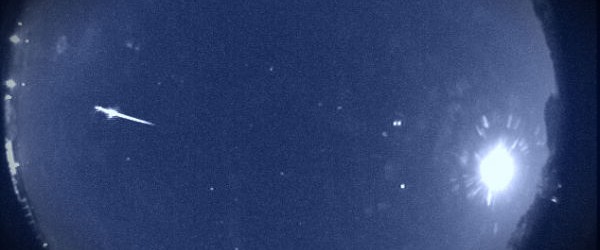
Most years the shower is weak, producing no more than five rather dim meteors every hour. But occasionally, the Taurids put on quite a show and fireballs streak across the sky. (Credit: AstroCal)
The Taurids are commonly slow-moving meteors that blaze across the sky in pale orange colors. Typically, Taurids appear at a rate of about 7 per hour, moving slowly across the sky at about 27 km/s (17 mps ). Meteoroids the size of pebbles and small stones are producing a slow drizzle of very bright fireballs when entering Earth’s atmosphere. This year’s Taurid peak is expected during the nights of November 5-12.

You can start skywatching at mid-evening on November 4-5, before the waning gibbous moon rises over your eastern horizon. You can see planet Jupiter low in the east. It shines in front of the constellation Taurus, the part of the sky from which the meteors appear to radiate. The Southern Taurids will peak on November 5, while the Northern Taurids will reach peak rates on November 12. The next meteor shower is the Leonids on the night of November 17.

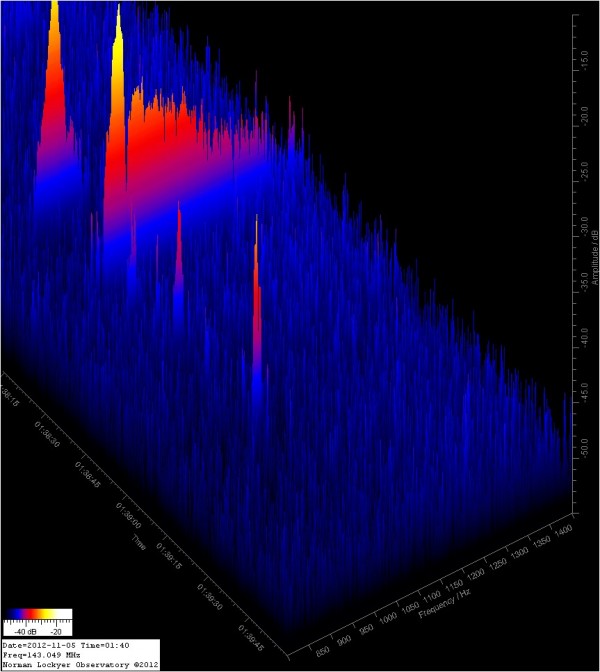
N.L.O. Meteor Detection Live View on November 5,2012 (Credit: MeteorScan)


Comet Encke

Comet Encke is thought by some astronomers to be a piece of a larger comet that broke up 20,000 to 30,000 years ago. Comet Encke is believed to be the originator of several related meteor showers known as the Taurids (which are encountered as the Northern and Southern Taurids across November, and the Beta Taurids in late June and early July). Encke orbits the Sun every 3.3 years - the shortest period of any known comet. Given Encke’s low orbital inclination near the ecliptic and brief orbital period of 3 years, the orbit of Encke is frequently perturbed by the inner planets. The diameter of the nucleus of Encke’s Comet is 4.8 km.

This image taken by NASA's Spitzer Space Telescope shows the comet Encke riding along its pebbly trail of debris (long diagonal line) between the orbits of Mars and Jupiter. (NASA/JPL-Caltech/M. Kelley (Univ. of Minnesota))

On April 20, 2007, STEREO-A observed the tail of Comet 2P/Encke to be temporarily torn off by magnetic field disturbances caused by a coronal mass ejection (CME). The tail grew back due to the continuous shedding of dust and gas by the comet.

The origin of the Taurids was reexamined by Whipple and S. Hamid during 1950. They calculated the effects of secular perturbations by Jupiter on the orbital inclination and longitude of perihelion of nine photographic meteor orbits and found the orbital planes of four of the meteors to coincide with that of comet Encke 4700 years ago. Three other orbits coincided with one another, but not with comet Encke 1500 years ago. The authors theorized “that the Taurid streams were formed chiefly by a violent ejection of material from Encke’s Comet some 4700 years ago, but also by another ejection some 1500 years ago, from a body moving in an orbit of similar shape and longitude of perihelion but somewhat greater aphelion distance….” It was suggested that this unknown body had separated from Encke some time in the past.

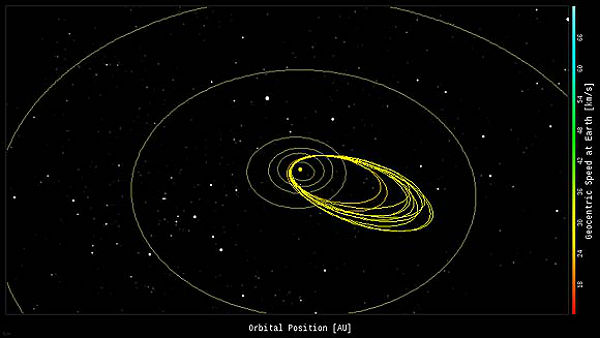
In the orbital diagram, the location of Earth is denoted by a red splat. The orbits of the meteoroids (yellow) roughly match that of parent Comet Encke (orange), confirming their association with the Taurid debris swarm.

Czechoslovakian astronomer Ä½ubor Kresák gave a theory that mysterious Tunguska event of 1908 was in fact a fragment of Comet Encke. One theory considers that impacts of Taurid debris fragments may have been responsible for the Bronze Age collapse in the Fertile Crescent, perhaps evidenced by a large meteor crater in Iraq. Ancient people may have experienced Tunguska-type events, which occur approximately every 300 years as calculated by Eugene Shoemaker.

During the week ending November 4, 2005, the large number of fireballs seen all over the world led some to suggest UFO visitations. These fireballs may have been space junk or the Taurids.

Source

Monday, November 5, 2012

Federal Judge BLOCKS FBI’s Attempts to Hold Back Information on Troubling Internet Surveillance Program

In a somewhat surprising move, U.S. District Judge Richard Seeborg refused to allow the government to continue to keep their drive to require Internet providers to build backdoors into their systems for government surveillance under a veil of secrecy.

This is especially shocking because a federal judge just ruled that police can place surveillance cameras on private property without a search warrant and another federal judge quickly overturned a previous decision blocking the indefinite detention provisions of the National Defense Authorization Act (NDAA) for Fiscal Year 2012.

The program, known as the “Going Dark,” is, according to Threat Level, aimed at “extend[ing] [the government’s] ability to wiretap virtually all forms of electronic communications.”

Judge Seeborg ruled on October 30 that the federal government “did not adequately respond to a Freedom of Information Act request from the Electronic Frontier Foundation,” according to CNET.

Seeborg ordered a “further review of the materials previously withheld” in the lawsuit seeking information on the “Going Dark” program.

The FBI’s program is aimed at actually forcing major companies including Apple, Facebook, Google, Microsoft and Yahoo to alter their systems in order to guarantee easy wiretap access.

One might point out that such a system is likely already in place in the case of Google, given their relationship to the National Security Agency (NSA) and other government entities.

Some could very well consider this FBI program even more troubling than it might otherwise be due to the dramatic increase in warrantless surveillance over recent years.

“We must ensure that our ability to obtain communications pursuant to court order is not eroded,” Robert Mueller, director of the FBI, to a Senate Committee in September, according to CNET.

Many companies are “are not required to build or maintain intercept capabilities” as of right now, according to Mueller, as if it is the responsibility of companies to enable illegal government surveillance.

The FBI argues that lawful investigations are hindered by Internet companies not being required to have backdoor surveillance systems in place in advance or because their systems prevent such surveillance.

This effort is nothing new, evidenced by the FBI requesting Internet giants to support new legislation which would require various websites and VoIP, instant messaging, email and social networking providers to put a system in place allowing for backdoor surveillance.

Mueller later confirmed that the bureau is indeed pushing for “some form of legislation” that would work towards such a requirement.

The ruling from Seeborg also requires the FBI to make it clear which documents related to Going Dark are actually being withheld from public scrutiny. The Electronic Frontier Foundation (EFF) has rightly called the FBI’s efforts to keep this program under wraps unreasonable and confusing.

Seeborg stated that both sides have 15 days to “meet and confer to negotiate a timetable for the FBI to complete [the revisions required].”

Unfortunately, Seeborg stopped short of actually ruling on what information must be turned over.

Currently the Department of Justice has only made 707 pages available of 2,662 pages that might be relevant and those released pages are heavily redacted, according to the EFF.

Indeed, the EFF pointed out that some pages had been removed entirely, in clear violation of the oft-abused open-government laws.

“Publicity (adverse or otherwise) regarding any internal FBI development projects (e.g. National Electronic Surveillance Strategy), and legislative strategy to make amendments to outdated laws, that these congressional staffers, and DOJ representatives, may be requested to provide input on, may seriously prejudice their effectiveness in helping on other developmental projects, and legislative strategies,” argued David Hardy, the section chief for the FBI’s record management division.

“These employees may have to give input on the development of strategy plans, like developing ways to enhance ELSUR [electronic surveillance] capabilities through legislative amendments,” Hardy continued. “The publicity associated with the release of these congressional staffers involved with an FBI developmental project could trigger hostility toward a particular employee.”

While the FBI remains tight-lipped on the decision, EFF staff attorney Jennifer Lynch said, “It’s nice to have a court say the government can’t do that.”

Lynch also stated that Seeborg’s ruling shows that the federal government indeed has to at least “make an effort” to comply with the Freedom of Information Act (FOIA).

The EFF requested the entirety of the records relating to Going Dark back in 2009 and in the second FOIA request filed in 2010 they requested examples of the surveillance allegedly being hindered by various social networks and VoIP services like Skype.

The EFF also sought documents relating the congressional briefings and meetings with representatives of the industry dealing with the Going Dark program.

However, the effort on the FBI’s part has a long history dating back almost ten years ago with a lobbying effort focusing on the Federal Communications Commission (FCC).

The FBI’s Electronic Surveillance Technology Section sought to force broadband providers to provide increasingly efficient and standardized surveillance facilities for the government, a request which was granted soon after by the FCC and upheld in 2006 by a federal appeals court.

If the FBI’s wishes are granted, the Communications Assistance for Law Enforcement Act (CALEA) of 1994 would be amended in order to include Internet companies as well as telecommunications providers currently covered by the law.

The FBI claims that expanding CALEA wouldn’t actually be expanding or creating a new wiretapping law since a court order would, at least in principle, still be required.

“But privacy groups and civil libertarians — and Internet companies — are hardly likely to embrace the idea,” Declan McCullagh points out in his article for CNET.

The battle over increasingly easy government surveillance will not likely end soon and based on the troubling precedents established as of late, the chances of the Constitution being honored over the interests of the federal government seem slim, at best.


source

Report Reveals Japanese Nuclear Safety Experts Received Large Sums of Money From Nuclear Industry

Destroyed unit 3 reactor building of Tokyo Electric Power Co.’s tsunami-crippled Fukushima Daiichi nuclear power plant is seen in Fukushima prefecture, Monday, Feb. 20, 2012. (Issei Kato)
While the “profoundly man-made disaster” at the Fukushima nuclear power plant continues unabated with independent experts continually blocked from gaining access, it has now been revealed that the six members of a Japanese government team drafting the new nuclear reactor safety standards have received tens of thousands of dollars from the nuclear industry.

According to a report put out by Japan’s Kyodo News a whopping four out of six experts on the panel drafting new safety standards have received funds from companies directly involved in the nuclear industry.

The grants, donations and compensation range from 3 million yen (around $37,290) to over 27 million yen (around $335,600) each, according to data released by the Nuclear Regulation Authority (NRA).

While the NRA claimed that the members of the panel “have been selected in line with rules, and there should be no problem,” Kyodo News rightly points out that critics “say the members’ judgments might be swayed by the wishes of donors, exposing safety regulations to the risk of being watered down.”

Indeed it seems so painfully obvious that it is somewhat laughable to even qualify such a statement with the word “might.”

The NRA requires experts like the ones assigned to draft the new safety standards to disclose the funds they receive but they have “no rules for disqualifying them in light of such information,” according to AFP.

One of the experts, Akira Yamaguchi, a professor at Osaka University, received at least 27.14 million yen in both donations and research grants from Mitsubishi Heavy Industries, Ltd., a company which just happens to manufacture nuclear plant equipment, along with “other relevant entities,” according to the report.

Akio Yamamoto, a professor at Nagoya University, received 10.1 million yen, also from a builder and operator of nuclear plants, Japan Atomic Power Co., along with other companies.

Yutaka Abe, a professor at Tsukuba University, received 5 million yen from various entities including a laboratory of the Tokyo Electric Power Company (TEPCO), the same company behind the atrocious Fukushima disaster.

Tomoyuki Sugiyama, a Japan Atomic Energy Agency researcher, received 3 million yen from Nuclear Fuel Industries, according to the report.

Meanwhile, the spent fuel pool at reactor four remains precarious and technology is being developed which, in theory at least, could assist the disturbingly slow cleanup process.

TEPCO, in what appears to be an attempt to maintain at least some shred of legitimacy, “plans to set up a regional headquarters in Fukushima prefecture to better oversee local reconstruction, decontamination and compensation payments, Kyodo and other media said,” according to AFP.


source

I am a Nuclear Reactor and this is What I Know

By Christina Consolo

Contributing writer for End the Lie and host of Nuked Radio

You know me. There are lots of us around. We sit behind concrete walls and high fences, and most of us can boast of a killer view.

My outside is pretty plain, but inside I have 10,000 parts. As a nuke plant, you are lucky, because you almost always get waterfront property. This is so if my insides ever get too hot, or the power goes out (oops!) it’s easy to scoop up water and dump it on me.

If my emergency diesel generators go out, which happens a lot, they can sometimes use fire hoses to cool me off, too. I’m glad the NRC spokesman brought that up the other day when Hurricane Sandy happened. A lot of people were probably worried about that. This exact same thing happened to some of my friends in Japan! Fire hoses seemed to work OK for them, but I’m not sure, because no one really talks about it. I think there might have been some explosions or something. Man do they have a nice view from there though! And I heard Pacific sushi is really good!

Some us of are right next to big cities too, so we never get lonely. When people see you a lot, it makes you seem like you belong. Sometimes they paint pretty pictures on us, to make us look more friendly! I hope they paint some birds and butterflies on me, I don’t see too many of those around anymore.

Some days I look around me and I see all that wind, water, and sun and I wonder why people haven’t used those things to generate power, too. Maybe they are just lazy. After all, they use it like crazy in third-world countries like Morocco!


I wish I didn’t vent so much steam too, because it really obscures my view. Some days its really bad, especially if we have a hot shutdown. But people have to work inside of me so I can work properly and things don’t “melt down”. Radiation in the steam is pretty small, so unless you go outside a lot, you’re probably OK. I’m not sure why so many kids around here keep getting brain cancer though. Maybe they sit too close to the TV.

Even if we don’t sit by a big city, we still aren’t lonely. There are lots of security guards around, in case a nun tries to throw blood on us or something! Lots of people don’t seem to like us, probably because they think we are dangerous. But that’s silly, there have only been a few big accidents that have happened, like Chernobyl and Fukushima, which killed lots of people, poisoned the environment forever (and made the ones that didn’t die sick!), or caused deformities in their kids. But when you think about how great nuclear power is, it all evens out!

Most of those people that live around nuclear reactors are poor anyway. The people that own me, probably don’t think they really count. And of course, the 99 other nuclear accidents that have happened most people don’t even know about, even though they’re listed on Wikipedia. They don’t like us to talk about it either. And you never ever talk about the spent fuel and nuclear waste! Or how precarious the fuel pools are, especially in the 23 Mark 1 BWR reactors in the US, the same style as Fukushima! That freaks people out a lot!

I hear some people that work inside me getting scared though, because we break down so much. All you have to do is look at the NRC event notification page to see! But it’s not my fault that I’m old! My owners don’t want to spend the money to fix me up right! They just fix stuff when it breaks. Hopefully it won’t be a big break, because then people will talk probably about us even more.


I’m actually not too worried about the election either, because it looks like both Obama and Romney are big fans of nuclear power. All of their friends are the people that own us. Their friends all own the news media too, so since we give them lots of money, they don’t talk bad about us. Now the Green Party, those people are just plain scary. They could possibly “shut us down”. But no one really listens to them. Most people are too busy watching TV I think. I should know, I make all that electricity for them!

The really funny thing is, electricity isn’t even the reason I was made… I was made to be a bomb-making factory! I kick out plutonium like a person craps after a big meal at a dirty taco stand! Then people from the government come along, scoop up this plutonium, and take it to labs all over the country. There, they figure out ways it can be used against other countries we don’t like, or the countries whose oil we want. Too bad our soldiers get sick from it too. I guess my owners must not care about them either.

Even if people got really mad at us, the NRC, who is like the babysitter that lets you get away with stuff your parents won’t, will re-license me endlessly so I can stay here forever. So I’m really not too worried about things. I would really hate to lose this view!

Maybe they will paint some fish on me too, because all the ones around here seem to be dead.